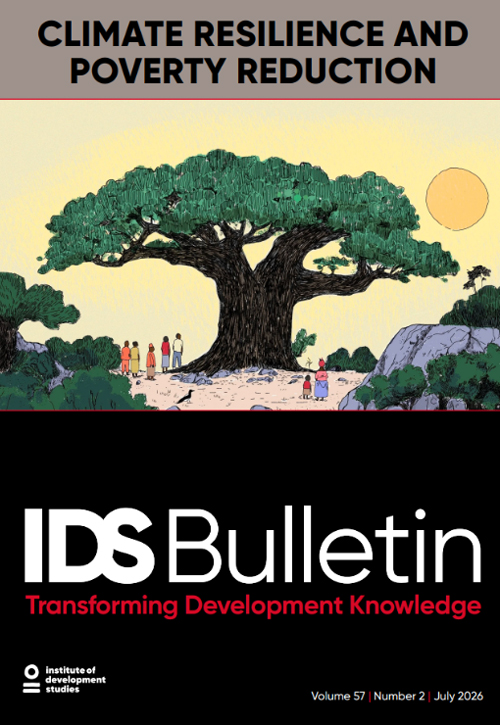
Volume 57 Number 2 July 2026
Edited by: Vidya Diwakar and Brian Mulenga
East and Southern Africa face a disproportionately high burden from climate change, which is posing a growing threat to poverty reduction in these regions. Given the dependence of poor and vulnerable rural populations on agricultural livelihoods, support programmes and policies urgently need to address weather shocks. However, the level of welfare or wellbeing at which these climate shocks can be resisted is often underestimated.
The research topics identified in this issue of the IDS Bulletin raise important questions for policy making and programme design: which policies, programmes, and investments will most effectively reduce the climate resilience threshold?
The articles in this IDS Bulletin highlight the mechanisms through which climate change drives negative poverty dynamics. They examine the role of adaptation and instruments in mitigating these negative impacts and identify policy pathways for building long‑term resilience to both poverty and climate change. The articles here provide entry points into what action might look like, for individuals, households, communities, nations, and international systems.
The evidence presented in this issue integrates consideration of different types of instruments, such as social protection, vocational training, and livelihood systems support, and considers the extent to which these are fit-for-purpose, and politically feasible, in order to address structural issues. There is also a clear argument that current climate finance is often not poverty focused, requiring a shift towards gender-sensitive, poverty-targeted, locally led programmes.
By consolidating this evidence, this issue of the IDS Bulletin aims to inform national and international policymakers, practitioners, and researchers seeking to design effective, context‑specific strategies that safeguard livelihoods in an era of increasing climate uncertainty.
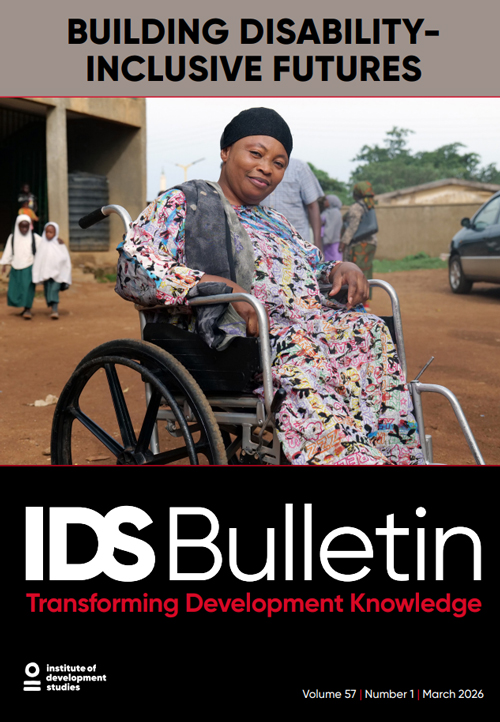
Volume 57 Number 1 March 2026
Edited by: Stephen Thompson, Brigitte Rohwerder, Claire Walsh and Gayatri Sekar
Whilst significant progress has been made in recent years with regard to ensuring that development interventions are more inclusive, people with disabilities still remain underrepresented in development programmes and research. The landmark adoption of the UN Convention on the Rights of Persons with Disabilities (CRPD) in 2006 changed how disability is considered within society, as well as within the development sector. But there is still so much to do before all interventions are meaningfully inclusive of people with disabilities.
This issue of the IDS Bulletin presents a collection of articles written by researchers and practitioners involved in the UK aid-funded Disability Inclusive Development (DID) programme. In particular, the articles include a focus on three broad themes: strengthening the evidence base; cross-cutting issues relevant to disability-inclusive development; and the central role of Organisations of Persons with Disabilities (OPDs).
Drawing together key insights and lessons across the DID programme, the articles explore a range of topics relating to disability and development such as health, education, safeguarding, transport, stigma, the most marginalised groups, the imperative role of OPDs, and disability-inclusive approaches to research and evaluations.
This is the first IDS Bulletin issue in its long history to have an explicit focus on disability.
The editorial team are very proud of this thematic focus, believing that disability must be mainstreamed within development discourse, programming, and research if no one is to be left behind. We are also pleased to say, this IDS Bulletin is produced in an accessible format that goes beyond the expectations linked to current publishing legislation.

Volume 56 Number 2 November 2025
Edited by: John Gaventa, Rosie McGee and Alex Shankland
A critical issue of our time is how the world can transition from a development model based on the extraction and use of fossil fuels to one based on cleaner sources of energy, and how it does so in a just and inclusive way.
Central to this issue of the IDS Bulletin is the recognition that to be just, any transition must include consideration of the voices, knowledges, and realities of communities most affected. By bringing together authors from both the global South and the global North, covering a wide range of communities affected by different dimensions of the energy transition, we find long histories of action and resistance developed around encounters with earlier transitions.
The articles in this IDS Bulletin highlight cases of advocacy being used to strengthen community voices to make the processes of consultation more inclusive and empowering of marginalised perspectives. In doing so they also address a less well documented citizen-led pathway that focuses on bottom-up forms of action through grass-roots innovation and social movements.
Given the multiple historical forms of injustice which surround energy production, struggles for just transition must ultimately involve multiple forms of justice – be they distributive, recognitional, procedural, restorative, or reparative.